
MegaMoE in FlashInfer: Fused Expert-Parallel MoE Kernels
The problem
A Mixture of Experts (MoE) architecture replaces standard dense feed-forward networks with a set of sparse sub-networks, and dynamically routes individual tokens to a top-K subset of experts. This allows the model to have large scaling in terms of weight at sub-linear computational scaling. But, large amounts of weights often do not fit into a single GPU. Serving large Mixture-of-Experts (MoE) models, hence relies on expert parallelism: each forward pass dispatches tokens to their assigned experts across GPUs, executes grouped GEMMs, and combines the outputs. Traditional implementations perform dispatch, quantization, GEMMs, and combine as separate stages, incurring repeated kernel launches, synchronization, and memory traffic. Communication and computation also tend to execute sequentially, leaving hardware resources underutilized.
Our approach
FlashInfer’s MegaMoE implementation fuses an MoE layer into a single persistent kernel per forward pass. The kernel performs dispatch, activation quantization, both grouped GEMMs, and result combination while overlapping communication and computation through symmetric (NVSHMEM) memory.
The implementation lives in flashinfer.moe_ep behind a single layer API with interchangeable backends, for eg.:
- NVFP4 (W4A4) — CuTe DSL implementation with 4-bit weights and activations using block-16 scaling
- MXFP8 (W8A8) — CuTe DSL implementation with 8-bit weights and activations using block-32 scaling
- DeepGEMM (W4A8) — integration of the existing fused DeepGEMM kernel, serving as both the baseline and fallback implementation
The combine-phase communication format can be configured as BF16, MXFP8, or NVFP4, allowing bandwidth to be traded against numerical precision when beneficial for larger workloads.
Kernel tuning is automatic by default through built-in heuristics and a persistent offline-tunable knob cache, with optional first-run autotuning (knobs="auto") or explicit user-provided tuning parameters.
Correctness is validated through three complementary mechanisms:
- PyTorch reference implementations for all compute paths
- Bit-exact expert-parallel vs. single-GPU multi-rank tests
- CUDA Graph capture and replay tests
Usage
These schematic examples show backend selection. Supply the layer parameters, process-group setup, inputs, and backend-specific kernel configuration for your deployment.
from flashinfer.moe_ep import MoEEpLayer, MegaConfig

layer = MoEEpLayer(
    ...,
    backend=MegaConfig(
        megakernel=megakernel_config,
        quantize_input=True,
        preprocess_weights=True,
    ),
)
output = layer.forward(inputs)
Weights are accepted in their standard checkpoint layout. The layer performs quantization, weight reordering, and symmetric-buffer allocation automatically.
In contrast to the MegaConfig, a user can also choose a split config, where the mega kernel configuration cannot fit. For example, because of topology or data type.
from flashinfer.moe_ep import MoEEpLayer, SplitConfig, NcclEpConfig

layer = MoEEpLayer(
    ...,
    backend=SplitConfig(
        comm=NcclEpConfig(),
        kernel=split_kernel_config,
    ),
)
output = layer.forward(inputs)
Performance
Unless otherwise noted, the results below were measured with vLLM 0.25.1 and FlashInfer moe_ep. We report three backends. native is vLLM’s own DeepGEMM MegaMoE implementation and serves as the baseline. fi_dg routes that same DeepGEMM MegaMoE kernel through FlashInfer moe_ep, so its ratio against native isolates integration overhead rather than kernel work. fi_cutedsl is FlashInfer’s NVFP4 CuteDSL MegaMoE backend, which is the new kernel under study.
Native and fi_dg use the original MX checkpoint, while fi_cutedsl uses the NVFP4 cast of the same base weights, so throughput comparisons should be read together with the accuracy gate below.
End-to-end results in vLLM
1x8 SM100 — DeepSeek-V4-Flash, EP8
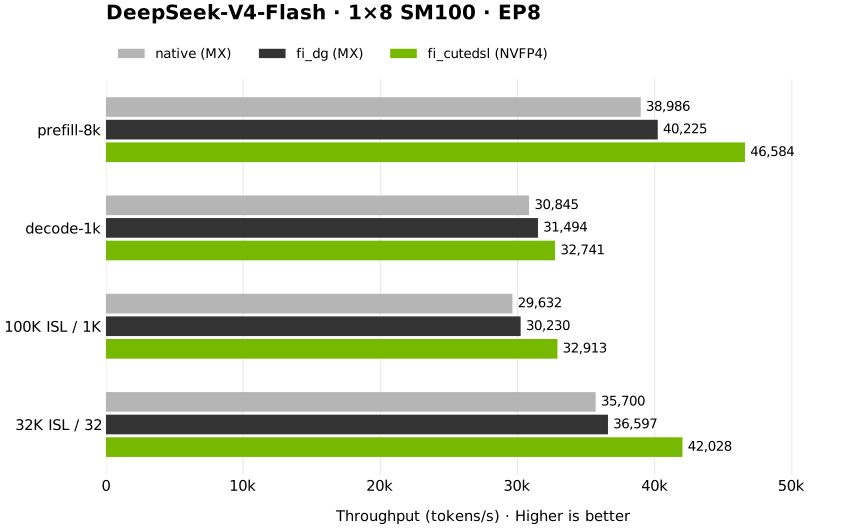
| cell | native tok/s | fi_dg | fi_cutedsl |
|---|---|---|---|
| prefill-8k | 38986 | 40225 (1.032x) | 46584 (1.195x) |
| decode-1k | 30845 | 31494 (1.021x) | 32741 (1.061x) |
| 100K ISL / 1K | 29632 | 30230 (1.020x) | 32913 (1.111x) |
| 32K ISL / 32 | 35700 | 36597 (1.025x) | 42028 (1.177x) |
Latency on the interactivity-sensitive cells also improves: TTFT drops from 49.3 s to 42.2 s at 100K ISL / 1K and from 15.1 s to 12.8 s at 32K ISL / 32, while ITL p50 improves from 56.1 ms to 51.9 ms and from 226.5 ms to 191.2 ms, respectively.
1x8 SM100 — DeepSeek-V4-Pro, EP8
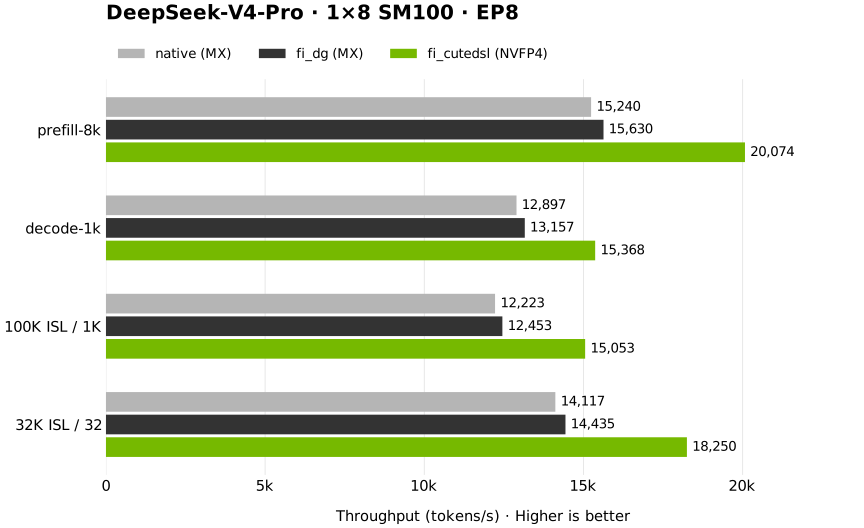
| cell | native tok/s | fi_dg | fi_cutedsl |
|---|---|---|---|
| prefill-8k | 15240 | 15630 (1.026x) | 20074 (1.317x) |
| decode-1k | 12897 | 13157 (1.020x) | 15368 (1.192x) |
| 100K ISL / 1K | 12223 | 12453 (1.019x) | 15053 (1.231x) |
| 32K ISL / 32 | 14117 | 14435 (1.023x) | 18250 (1.293x) |
The latency gains are larger on the bigger model. At 100K ISL / 1K, TTFT improves from 122.3 s to 95.0 s; at 32K ISL / 32, it improves from 38.4 s to 29.5 s. ITL p50 improves from 134.3 ms to 111.8 ms and from 573.9 ms to 441.3 ms on the two interactivity cells.
Across both models, fi_dg stays near 1.02x, indicating that the moe_ep wrapper adds effectively no measurable overhead in this configuration. The gain for the NVFP4 configuration is represented by fi_cutedsl, which improves throughput by 1.06x to 1.20x on DeepSeek-V4-Flash and by 1.19x to 1.32x on DeepSeek-V4-Pro.
1x4 SM103 — DeepSeek-V4-Flash, EP4/TP4
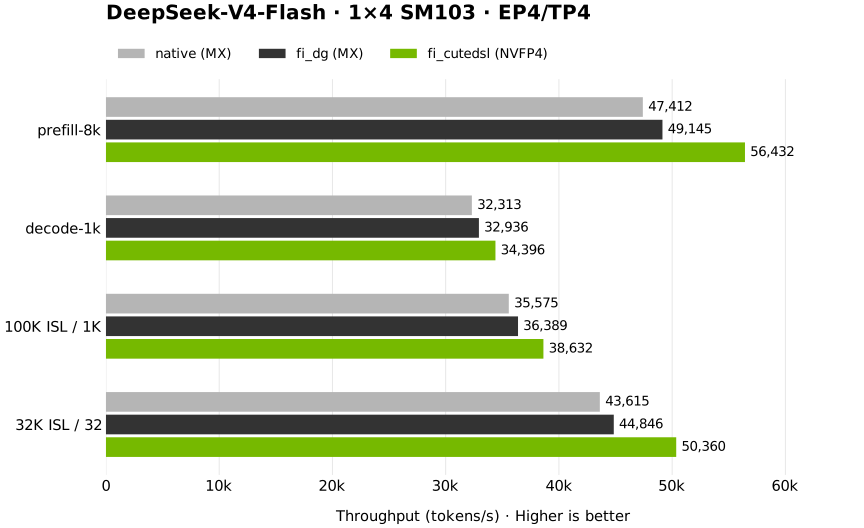
| cell | native tok/s | fi_dg | fi_cutedsl |
|---|---|---|---|
| prefill-8k | 47412 | 49145 (1.037x) | 56432 (1.190x) |
| decode-1k | 32313 | 32936 (1.019x) | 34396 (1.064x) |
| 100K ISL / 1K | 35575 | 36389 (1.023x) | 38632 (1.086x) |
| 32K ISL / 32 | 43615 | 44846 (1.028x) | 50360 (1.155x) |
Latency on the interactivity cells also improves: TTFT drops from 40.4 s to 35.2 s at 100K ISL / 1K and from 12.4 s to 10.6 s at 32K ISL / 32, while ITL p50 improves from 47.1 ms to 44.7 ms and from 184.9 ms to 159.0 ms.
The 1x4 SM103 pattern matches the 1x8 SM100 sweep cell for cell: fi_dg stays near wrapper parity, while fi_cutedsl posts the largest gains on the prefill-heavy cells and the smallest gain on decode-1k.
Kernel microbenchmarks
1x8 SM100 — DeepSeek-V4-Flash geometry
| tok/rank | dg | nvfp4 bf16 | +ikr | +combine_nvfp4 | +combine_mxfp8 |
|---|---|---|---|---|---|
| 512 | 154.7 | 189.4 (0.82x) | 192.0 (0.81x) | 168.9 (0.92x) | 173.1 (0.89x) |
| 1024 | 233.5 | 232.4 (1.00x) | 237.0 (0.99x) | 197.5 (1.18x) | 205.9 (1.13x) |
| 2048 | 379.1 | 334.8 (1.13x) | 334.8 (1.13x) | 273.4 (1.39x) | 287.7 (1.32x) |
| 4096 | 680.0 | 578.5 (1.18x) | 574.4 (1.18x) | 422.9 (1.61x) | 472.0 (1.44x) |
| 8192 | 1320.4 | 1104.8 (1.20x) | 1091.7 (1.21x) | 772.2 (1.71x) | 887.3 (1.49x) |
1x8 SM100 — DeepSeek-V4-Pro geometry
| tok/rank | dg | nvfp4 bf16 | +ikr | +combine_nvfp4 | +combine_mxfp8 |
|---|---|---|---|---|---|
| 512 | 376.9 | 394.3 (0.96x) | 398.3 (0.95x) | 377.8 (1.00x) | 382.0 (0.99x) |
| 1024 | 492.1 | 441.3 (1.12x) | 444.4 (1.11x) | 418.8 (1.18x) | 426.9 (1.15x) |
| 2048 | 899.1 | 626.2 (1.44x) | 664.0 (1.35x) | 572.4 (1.57x) | 586.7 (1.53x) |
| 4096 | 1591.8 | 1023.0 (1.56x) | 1036.2 (1.54x) | 941.1 (1.69x) | 962.0 (1.65x) |
| 8192 | 3144.2 | 1919.0 (1.64x) | 1945.0 (1.62x) | 1716.7 (1.83x) | 1727.9 (1.82x) |
Across the SM100 measurements, the crossover point sits between roughly 512 and 1024 tokens per rank. Below that region, deep_gemm_mega usually wins or stays at parity; above it, the CuteDSL variants pull ahead, and the quantized combine-wire variants extend the lead further at larger token counts.
1x4 SM103 — DeepSeek-V4-Flash geometry
| tok/rank | dg | nvfp4 bf16 | +ikr | +combine_nvfp4 | +combine_mxfp8 |
|---|---|---|---|---|---|
| 512 | 197.5 | 231.1 (0.85x) | 229.3 (0.86x) | 216.1 (0.91x) | 220.2 (0.90x) |
| 1024 | 229.4 | 259.9 (0.88x) | 260.1 (0.88x) | 233.4 (0.98x) | 241.7 (0.95x) |
| 2048 | 364.5 | 331.5 (1.10x) | 334.8 (1.09x) | 275.5 (1.32x) | 291.8 (1.25x) |
| 4096 | 610.3 | 533.5 (1.14x) | 531.4 (1.15x) | 398.3 (1.53x) | 442.3 (1.38x) |
| 8192 | 1123.3 | 988.2 (1.14x) | 976.9 (1.15x) | 698.0 (1.61x) | 803.8 (1.40x) |
On 1x4 SM103, the same pattern holds but the crossover moves up: because EP4 assigns twice as many experts per rank as EP8, the crossover generally shifts to roughly 1024 to 2048 tokens per rank. That is why the decode-1k gain is smaller on SM103 end-to-end, while the larger prefill-heavy cells still benefit more clearly.
Split path and MXFP8, BF16 microbenchmarks (1x8 SM100)
Mega-path columns below are e2e_pipelined p50 microseconds. Split-path columns below are nccl_ep HT barrier-cold e2e p50 microseconds.
DeepSeek-V4-Flash
| tok/rank | dg | nvfp4 bf16 | mxfp8 | bf16 | split fp4t | split fp4c | split w4a8 |
|---|---|---|---|---|---|---|---|
| 8 | 108.5 | 121.7 (0.89x) | 171.1 (0.63x) | 336.9 (0.32x) | 1642.2 | 832.5 | 928.4 |
| 64 | 125.4 | 134.1 (0.94x) | 197.7 (0.63x) | 392.2 (0.32x) | 1922.1 | 884.8 | 968.4 |
| 512 | 157.8 | 191.4 (0.82x) | 263.2 (0.60x) | 433.7 (0.36x) | 1643.1 | 1158.6 | 1410.0 |
| 2048 | 383.0 | 335.5 (1.14x) | 437.1 (0.88x) | 822.2 (0.47x) | 4811.5 | 3979.9 | 4949.4 |
| 8192 | 1324.1 | 1101.9 (1.20x) | 1364.0 (0.97x) | 2705.9 (0.49x) | 11777.9 | 9423.6 | 13437.1 |
DeepSeek-V4-Pro
| tok/rank | dg | nvfp4 bf16 | mxfp8 | bf16 | split fp4t | split fp4c | split w4a8 |
|---|---|---|---|---|---|---|---|
| 8 | 260.2 | 259.1 (1.00x) | 467.9 (0.56x) | 1032.7 (0.25x) | 2636.0 | 1741.6 | 1424.5 |
| 64 | 329.7 | 334.8 (0.98x) | 646.1 (0.51x) | 1449.0 (0.23x) | 2478.1 | 1631.9 | 1716.3 |
| 512 | 374.8 | 394.3 (0.95x) | 732.3 (0.51x) | 1580.0 (0.24x) | 2526.9 | 1838.3 | 2326.0 |
| 2048 | 884.3 | 618.9 (1.43x) | 1166.4 (0.76x) | 2434.1 (0.36x) | 7631.7 | 6317.2 | 8096.2 |
| 8192 | 3176.0 | 1890.2 (1.68x) | 3552.3 (0.89x) | 7117.0 (0.45x) | 22681.1 | 19984.6 | 27969.3 |
NCCL_EP vs NIXL_EP transport comparison
Identity-kernel comm-only comparison from the latest split-path measurements; values are barrier-cold e2e p50 microseconds.
| tok/rank | Flash nccl_ep HT | Flash nccl_ep LL | Flash nixl_ep LL | Pro nccl_ep HT | Pro nccl_ep LL | Pro nixl_ep LL |
|---|---|---|---|---|---|---|
| 8 | 315.9 | 113.0 | 127.8 | 229.1 | 124.4 | 82.7 |
| 64 | 315.2 | 144.2 | 87.2 | 799.2 | 599.4 | 98.4 |
| 512 | 315.9 | 186.9 | 165.0 | 367.3 | 239.0 | 258.6 |
| 2048 | 1973.5 | 413.3 | — | 2193.3 | 640.6 | — |
| 8192 | 3154.8 | 1372.8 | — | 3953.8 | 2355.0 | — |
fp4t= split NVFP4 TRT-LLM path.fp4c= split NVFP4 CuteDSL path.w4a8= split W4A8 CuteDSL path.nixl_epLL is—at 2048 and 8192 tok/rank becausemax_tokens_per_rankis capped at 1024.
Accuracy gate
| setup | model | native | fi_dg | fi_cutedsl | delta |
|---|---|---|---|---|---|
| 1x8 SM100 | Flash | 0.965 | 0.965 | 0.965 | +0.000 |
| 1x8 SM100 | Pro | 0.880 | 0.880 | 0.890 | +0.010 |
| 1x4 SM103 | Flash | 0.965 | 0.965 | 0.975 | +0.010 |
Because fi_cutedsl runs an NVFP4-cast checkpoint rather than the MX checkpoint used by native and fi_dg, the throughput comparison needs to be considered alongside model quality. On these 200-question GSM8K runs, the measured deltas are zero to one percentage point. This small evaluation is a quality check for the reported configurations, not evidence of equivalent accuracy across tasks.
Architecture support
| architecture | status |
|---|---|
| SM100/SM103 | Implemented |
| SM90 | Implemented |
| SM120 kernel | Implemented |
| SM107 | Pending |
Takeaways
The main conclusions are:
fi_dgstays near parity withnative, so the FlashInfermoe_epintegration adds effectively no measurable overhead in the tested EP8 configuration.- The throughput gain is measured for the CuteDSL NVFP4 configuration, including its different checkpoint precision.
- The gain appears consistently in both kernel and end-to-end measurements.
- The gain increases with larger token counts and larger model geometry.
- The reported GSM8K check accompanies the cross-checkpoint comparison; broader quality evaluation remains future work.
Future work
The following items remain active development directions rather than committed milestones:
- Backpropagation support in collaboration with cudnn-frontend.
- Broader model-level evaluation of the low-precision backends.
Part of FlashInfer v0.7. See the release highlights for upgrade details.
Comments